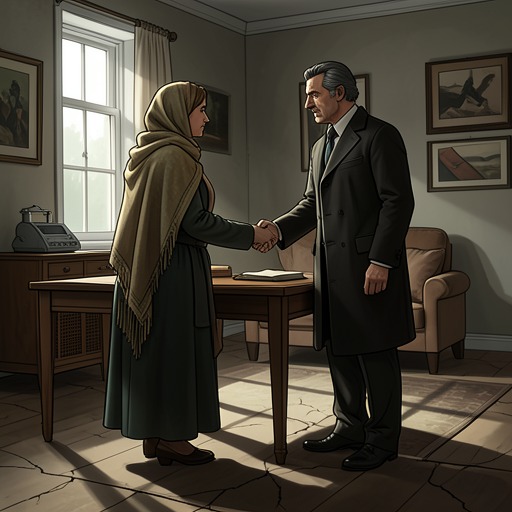
Adam Fairley and Elizabeth Harte's Romance and Miscarriage
A Woman of SubstanceAdam Fairley and Elizabeth Harte’s romance and the loss of their unborn child became a concealed history with consequences across generations. As Jim Fairley eventually revealed to Emma Harte, the relationship had been more than a youthful friendship: Adam and Elizabeth had loved one another, and a pregnancy, a miscarriage, and the choices that followed ended their hope of building a life together. Their story helps explain the old hostility between the Harte and Fairley families, while its delayed disclosure becomes part of the reconciliation of their descendants.
The concealed romance
For years, Emma had suspected that her mother and Adam had shared a bond. The clue was a small painted stone portrait of Elizabeth. Adam had painted it, but when his son brought it to him after Olivia Wainright’s death, Adam would not accept it. He explained that the portrait was Elizabeth, not Olivia, and disclosed the love they had once shared. The object thus carried a history that Emma had intuited without knowing its details: her mother’s image had survived where the story of her relationship with Adam had not.
Jim brought the stone to Emma and explained that Adam had later confided the fuller account to Jim’s grandfather. This revelation turned the portrait from a puzzling likeness into evidence of an intimate connection. Emma recognized that her longstanding suspicion of a friendship between her mother and Adam had been correct, but she had not known that they had been lovers. The account reached her not as an ordinary memory of her own, but as a family secret passed through generations and finally entrusted to her.
Pregnancy, loss, and separation
According to Jim’s account, Elizabeth became pregnant by Adam and left Fairley. Adam found her several weeks later in Ripon. By then, he had resolved to abandon his military career, defy his father, and emigrate to America with her. The plan was an attempt to choose a shared future over the expectations that governed his life; it arrived when the circumstances had already changed irrevocably.
Elizabeth had miscarried. Adam did not know whether the loss had happened naturally or resulted from the intervention of a midwife. Elizabeth was gravely ill and came close to dying. Once she recovered, she would not agree to Adam’s proposed elopement. She returned to Fairley and soon married Jack Harte, while the relationship with Adam ended without a further conversation between them. Adam’s willingness to leave his military future and challenge his father could not undo the loss or persuade Elizabeth to begin again with him.
The account also preserves the limits of what can be known. Adam’s uncertainty about the cause of the miscarriage remains unresolved, and Emma cannot identify how she first sensed that her mother and Adam had been connected. She wonders whether, as a child, she overheard a family quarrel or encountered local gossip, but finds no answer. The narrative reveals the relationship while leaving the origins of Emma’s half-knowledge obscure.
The secret’s effect on Emma
The revelation gives Emma a new way to understand her own inherited hostility toward Adam. As she absorbs the story, she recognizes that her hatred may have been linked to an old wound she could not consciously name. The discovery does not erase the pain attached to the families’ history; it makes that pain legible as part of a pattern of thwarted love, loss, and silence.
That pattern has an echo in Emma’s own youth. When she told Edwin Fairley that she was pregnant, he considered marriage but remained silent, fearing his father’s anger, the loss of his prospects as a barrister, and the gulf between the gentry and a village servant. Emma understood his silence as a rejection and left. Her experience differs from Elizabeth’s, but it repeats the way class pressure and family expectation can turn love into separation. In both stories, a woman’s pregnancy makes a private relationship impossible to keep safely private, while the man’s response is shaped by the social world he fears losing.
Emma’s later choices show how legal identity and social respectability continued to shape the consequences of unmarried pregnancy. When Blackie O’Neill pointed out that the birth registration required a father’s name, Emma refused to name the real father. Blackie offered to have his own name entered instead of leaving the father unknown, while acknowledging that this would not change Edwina’s illegitimate status. Years later, when Emma accepted Joe Lowther’s proposal, she told him that Edwina was illegitimate but concealed the father’s identity. The earlier family secret thus formed part of a continuing effort to protect a child while navigating the limits imposed by law and convention.
A turning point between generations
Adam’s story reaches Emma at a moment when the old family antagonism can still determine the future. He had asked, through the message conveyed by Jim, that Emma allow the next generation’s relationship to succeed where the previous ones had failed. Emma had already reversed her opposition to Paula and Jim’s marriage. She told Paula that the Fairley family had brought her pain since she was fourteen, but that she no longer wanted her pride and bitterness to obstruct her granddaughter’s happiness. She could now imagine a Fairley bringing joy into her life as well as pain.
The timing gives the revelation particular force: Emma’s approval was not secured by the story, since she had changed her mind before Jim delivered Adam’s message. Instead, the account confirms the significance of the decision she had already made and lets her see it within a longer family history. The painted stone becomes both a keepsake of her mother and a material link between two families whose members had repeatedly been crossed in love. By accepting Paula and Jim’s marriage, Emma acts on the possibility that the old separation need not be repeated.